Loading
Scheffel Boyle
  • Home
  • About Us
    • Our Team
    • Our Values
    • Scheffel Boyle News
    • Professional Affiliations
    • Client Testimonials
    • Peer Review
    • Scheffel Boyle Shares
    • BDO Alliance USA
  • Services
    • Tax Planning & Preparation
    • Audit & Assurance
    • Accounting Services
    • Consulting Services
    • Financial Advisory
  • Clients & Industries
    • Construction
    • Financial Institutions
    • Agribusiness
    • Governmental Entities
    • Non-Profit Organizations
    • Privately-Held Businesses
    • Individual Clients
    • Employee Benefit Plans
  • Resources
    • Knowledge Center
    • Coronavirus Resource Center
    • Helpful Links
  • Careers
    • Benefits
    • Available Opportunities
    • College Students
  • Contact Us
    • Locations
      • Alton, IL
      • Belleville, IL
      • Carrollton, IL
      • Columbia, IL
      • Edwardsville, IL
      • Highland, IL
      • Jerseyville, IL
  • Click to open the search input field Click to open the search input field Search
  • Menu Menu
  • Link to Facebook
  • Link to LinkedIn

Mortgage Matters: To Pay Down or Not to Pay Down

September 26, 2019
If you’re a homeowner and manage your finances well, you might have extra cash after you’ve paid your monthly bills. What should you do with this extra money? Some would say make additional mortgage payments toward your principal to pay off your mortgage early. Others would say: No, invest those dollars in the stock market!

The decision is very much about risk vs. return. There’s little, if any, risk in prepaying a mortgage, because you already know what your rate of return will be: the interest rate on your mortgage. For instance, if your mortgage interest rate is 4.5%, this would be the return earned by every dollar that goes toward prepayment (not factoring in the mortgage interest deduction if you qualify).

However, if you invest the money in the stock market, you’ll assume much more risk. The level of risk depends on the assets you invest in, but there’s no such thing as a risk-free investment.

Your mortgage interest rate is indeed an important factor. If your rate is relatively low, so is the return from prepaying your mortgage. The final decision for many people comes down to whether they believe they can earn a higher return investing the money than they would prepaying their mortgage.

Clearly there’s the potential to outperform your mortgage interest rate by investing your money for the long term. Remember, though, that the stock market may be volatile in the short term and offers no guarantees.

There’s no single answer to the “pay down the mortgage or invest in the market?” question. We can provide additional, more specific guidance on making the right decision for you.

Copyright © 2019

https://scheffelboyle.com/wp-content/uploads/2019/09/pexels-photo-221540.jpeg 1500 1999 brett@bonniburns.com https://scheffelboyle.com/wp-content/uploads/2022/06/Transparent-Logo-5.png brett@bonniburns.com2019-09-26 11:10:392019-09-26 14:55:37Mortgage Matters: To Pay Down or Not to Pay Down

Cost Segregation Studies Can Benefit Business Owners

September 20, 2019
Any business owner who’s acquired, constructed or substantially improved a building this year — or even in previous years — should read up on the tax benefits of a cost segregation study. Undertaking one may allow you to accelerate depreciation deductions, which reduce current taxes and boost cash flow.


Real vs. Tangible

IRS rules generally allow you to depreciate commercial buildings over 39 years. Most times, you’ll depreciate a building’s structural components (such as walls, windows, HVAC systems, elevators, plumbing and wiring) along with the building, and therefore over its same recovery period. Personal property (such as equipment, machinery, furniture and fixtures) is eligible for accelerated depreciation, usually over five or seven years. And land improvements (fences, outdoor lighting and parking lots, for example) are depreciable over 15 years.

Too often, businesses allocate all or most of a building’s acquisition or construction costs to real property, overlooking opportunities to allocate costs to shorter-lived personal property or land improvements. A cost segregation study combines accounting and engineering techniques to identify building costs that are properly allocable to tangible personal property rather than real property.

Enhanced Breaks

The Tax Cuts and Jobs Act enhanced certain depreciation-related tax breaks, which has in turn renewed interest in cost segregation studies. Among other things, the act permanently increased limits on Section 179 expensing. Sec. 179 allows you to immediately deduct the entire cost of qualifying equipment or other fixed assets up to specified thresholds.

Furthermore, it increased first-year bonus depreciation from 50% to 100% for qualified property acquired and placed in service after September 27, 2017, and before January 1, 2023.

Consider It

Under the right circumstances, a cost segregation study can yield substantial tax benefits. But every business may not need to undertake the time, energy and expense to conduct one. To find out whether a study would be worthwhile for your company, contact us.

Copyright © 2019

https://scheffelboyle.com/wp-content/uploads/2019/09/pexels-photo-544965.jpeg 1500 2250 brett@bonniburns.com https://scheffelboyle.com/wp-content/uploads/2022/06/Transparent-Logo-5.png brett@bonniburns.com2019-09-20 11:06:332019-09-26 14:56:39Cost Segregation Studies Can Benefit Business Owners

We have a new CPA!

September 19, 2019

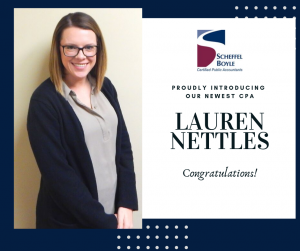
We’d like to wish a big CONGRATULATIONS to Lauren Nettles from our Carrollton office for officially passing all parts of the CPA Exam! We are so proud of all you’ve accomplished and can’t wait to see where you go from here.

https://scheffelboyle.com/wp-content/uploads/2019/09/NETTLES-CPA.png 788 940 brett@bonniburns.com https://scheffelboyle.com/wp-content/uploads/2022/06/Transparent-Logo-5.png brett@bonniburns.com2019-09-19 09:42:212020-01-28 15:22:49We have a new CPA!

Look Out for These Upcoming Tax Deadlines!

September 15, 2019
October 15 — Personal federal income tax returns for 2018 that received an automatic six-month extension must be filed today and any tax, interest and penalties due must be paid.
  • The Financial Crimes Enforcement Network (FinCEN) Report 114, “Report of Foreign Bank and Financial Accounts” (FBAR), must be filed by today, if not filed already, for offshore bank account reporting. (This report received an automatic extension to today if not filed by the original due date of April 15.)
  • If a six-month extension was obtained, calendar-year C corporations should file their 2018 Form 1120 by this date.
  • If the monthly deposit rule applies, employers must deposit the tax for payments in September for Social Security, Medicare, withheld income tax and nonpayroll withholding.

October 31 — The third quarter Form 941 (“Employer’s Quarterly Federal Tax Return”) is due today and any undeposited tax must be deposited. (If your tax liability is less than $2,500, you can pay it in full with a timely filed return.) If you deposited the tax for the quarter in full and on time, you have until November 12 to file the return.

  • If you have employees, a federal unemployment tax (FUTA) deposit is due if the FUTA liability through September exceeds $500.

November 15 — If the monthly deposit rule applies, employers must deposit the tax for payments in October for Social Security, Medicare, withheld income tax and nonpayroll withholding.

December 16 — Calendar-year corporations must deposit the fourth installment of estimated income tax for 2019.

  • If the monthly deposit rule applies, employers must deposit the tax for payments in November for Social Security, Medicare, withheld income tax and nonpayroll withholding.

Copyright © 2019

https://scheffelboyle.com/wp-content/uploads/2019/09/pexels-photo-1178684.jpeg 751 1000 brett@bonniburns.com https://scheffelboyle.com/wp-content/uploads/2022/06/Transparent-Logo-5.png brett@bonniburns.com2019-09-15 10:57:512019-09-26 14:55:12Look Out for These Upcoming Tax Deadlines!

Is “Bunching” Medical Expenses Still Feasible in 2019?

September 12, 2019

Some medical expenses may be tax deductible, but only if you itemize deductions and you have enough expenses to exceed the applicable floor for deductibility. With proper planning, you may be able to time controllable medical expenses to your tax advantage.

The Tax Cuts and Jobs Act (TCJA) made bunching such expenses beneficial for some taxpayers. At the same time, certain taxpayers who’ve benefited from the medical expense deduction in previous years might no longer benefit because of the TCJA’s increase to the standard deduction.

The Changes

Various limits apply to most tax deductions, and one type of limit is a “floor,” which means expenses are deductible only to the extent that they exceed that floor (typically a specific percentage of your income). One example of a tax break with a floor is the medical expense deduction.

Because it can be difficult to exceed the floor, a common strategy is to “bunch” deductible expenses into one year where possible. The TCJA reduced the floor for the medical expense deduction for 2017 and 2018 from 10% to 7.5% of adjusted gross income (AGI).

However, beginning January 1, 2019, taxpayers may once again deduct only the amount of the unreimbursed allowable medical care expenses for the year that exceeds 10% of their AGI. Medical expenses that aren’t reimbursed by insurance or paid through a tax-advantaged account (such as a Health Savings Account or Flexible Spending Account) may be deductible.

Itemized Deductions

If your total itemized deductions won’t exceed your standard deduction, bunching medical expenses into 2019 won’t save you tax. The TCJA nearly doubled the standard deduction. For 2019, it’s $12,200 for singles and married couples filing separately, $18,350 for heads of households, and $24,400 for married couples filing jointly.

If your total itemized deductions for 2019 will exceed your standard deduction, then bunching nonurgent medical procedures and other controllable expenses into 2019 may allow you to exceed the floor and benefit from the medical expense deduction. Controllable expenses might include prescription drugs, eyeglasses, contact lenses, hearing aids, dental work, and some types of elective surgery.

Exploring the Concept

As mentioned, bunching doesn’t work for everyone. For help determining whether you could benefit, please contact us.

Copyright © 2019

https://scheffelboyle.com/wp-content/uploads/2019/09/pexels-photo-1498933.jpeg 1500 1000 brett@bonniburns.com https://scheffelboyle.com/wp-content/uploads/2022/06/Transparent-Logo-5.png brett@bonniburns.com2019-09-12 10:47:332019-09-26 14:55:02Is “Bunching” Medical Expenses Still Feasible in 2019?

Step Carefully with Loans Between a Business and its Owner

September 6, 2019
It’s common for owners of closely held businesses to transfer money into and out of the company. But it’s critical to make such transfers properly. If you don’t, you might hear from the IRS.


Why Loans are Better

When an owner withdraws funds from the company, the transfer can be characterized as compensation, a distribution or a loan. Loans aren’t taxable, but compensation is and distributions may be taxable.

If the company is a C corporation, distributions can trigger double taxation — in other words, corporate earnings are taxed once at the corporate level and then again when they’re distributed to shareholders (as dividends). Compensation is deductible by the corporation, so it doesn’t result in double taxation. (But it will be subject to payroll taxes.)

If the business is an S corporation or other pass-through entity, there’s no entity-level tax, so double taxation won’t be an issue. Still, loans are advantageous because compensation would be taxable to the owner (and incurs payroll taxes), and distributions, even though maybe not taxable themselves, would reduce an owner’s tax basis, which makes it much harder to deduct business losses.

There are also some advantages to treating advances from owners as loans. If they’re treated as contributions to equity, for example, any reimbursements by the company may be treated as distributions and possibly be taxable in a C corporation situation.

Loan payments, on the other hand, aren’t taxable, apart from the interest, which is deductible by the company. A loan may also give the owner an advantage in the event of the company’s bankruptcy, because debt obligations are paid before equity is returned.

How to Define It

Establishing that an advance or a withdrawal is truly a loan is important. If you don’t make that distinction, and the IRS determines that a payment from the business is really a distribution or compensation, you (and, possibly, the company) could end up owing back taxes, penalties and interest.

Whether a transaction is a loan is a matter of intent. It’s a loan if the borrower has an unconditional intent to repay the amount received and the lender has an unconditional intent to obtain repayment.

Unfortunately, even if you intend for a transaction to be a loan, the IRS and the courts aren’t mind readers. So, it’s critical that you document any loans and treat them like other arm’s-length transactions. Among other things, you should execute a promissory note and charge a commercially reasonable rate of interest — generally, no less than the applicable federal rate.

Set and follow a fixed repayment schedule and secure the loan using appropriate collateral. (This will also give the lender bankruptcy priority over unsecured creditors.) And you must treat the transaction as a loan in the company’s books. Last, you must ensure that the lender makes reasonable efforts to collect in case of default. Also, for borrowers who are owner-employees, you need to ensure that they receive reasonable salaries, to avoid a claim by the IRS that loans are disguised compensation.

Looking Good

The IRS keeps a wary eye on business owners who borrow from themselves. We can help you through the process to withstand the scrutiny of the agency’s gaze.

Copyright © 2019

https://scheffelboyle.com/wp-content/uploads/2019/09/pexels-photo-870902.jpeg 1500 2396 brett@bonniburns.com https://scheffelboyle.com/wp-content/uploads/2022/06/Transparent-Logo-5.png brett@bonniburns.com2019-09-06 10:41:082019-09-26 14:54:52Step Carefully with Loans Between a Business and its Owner

Pages

  • 2025 Seminar Registration
  • 2025 Seminar Registration Presentation Slides
  • 2026 Summer Sneak Peek
  • About Us
  • Accounting and Office Manager
  • Accounting Clerk
  • Accounting Services
  • Administrative Assistant
  • Administrative Assistant – Columbia Office
  • Administrative Assistant – Edwardsville Office
  • Administrative Support Specialist
  • Administrative Support Specialist
  • AGCI Webinar Presentation
  • Agribusiness
  • Alton, IL
  • Andrea Suhre
  • Andrea Suhre
  • Audit & Assurance
  • Available Opportunities
  • BDO Alliance USA
  • Belleville, IL
  • Bookkeeper
  • Bookkeeper/Payroll Specialist
  • Brian Otten
  • Business Valuations
  • Careers
  • Carrollton, IL
  • Columbia, IL
  • Construction Accounting
  • Construction Newsletter
  • Construction Tax Seminar Presentation
  • Consulting Services
  • Contact Us
  • Coronavirus Resource Center
  • Cory E. Gallivan
  • Crystal Bock
  • Crystal Bock
  • Dale Holtmann
  • Daniel Phipps
  • Data Entry Assistants
  • Dennis E. Ulrich
  • E-News Sign Up
  • Edwardsville, IL
  • Elements
  • Employee Benefit Plans
  • Experienced Accountants
  • Experienced Public Accountant
  • Financial Calculators
  • Financial Institution
  • FOCUS Internship Program
  • Full-Time Interview Sign-Up
  • George Moore
  • Governmental Entities
  • Heather Clugston
  • Helpful Links
  • Highland, IL
  • Home
  • Howard Held
  • Individual Clients
  • Industries
  • Interview Thank You
  • Interview Timeslots
  • IT Support Specialist
  • Jerseyville, IL
  • Julie Billeter
  • Julie Graham
  • Kathy Fitzgerald
  • Keith Brinkmann
  • Knowledge Center
  • Lisa Bohnenstiehl
  • Locations
  • Mark Korte
  • Marketing Specialist
  • Michael D. Ulrich
  • Michael E. Fitzgerald
  • Michael T. Brokering
  • Non-Profit Organizations
  • Office Accounting Assistant
  • Our Team
  • Outsourced Accountant
  • Part-Time Bookkeeper
  • Payroll Assistant
  • Payroll Supervisor
  • Peer Review
  • Privacy Policy
  • Privately-Held Businesses
  • Professional Affiliations
  • Recruiting Events
  • Recruiting/Human Resources Coordinator
  • Resources
  • Robyn M. Klingler
  • Russell Gregson
  • Sarah Smith
  • Scheffel Boyle News
  • Scheffel Boyle Shares
  • Scott Weber
  • Seasonal Tax Preparer
  • Services
  • SIBA Webinar Presentation
  • Sneak Peek Survey
  • Spring Tax Internship Program 2026
  • STL Ag Club Webinar Prez
  • Summer Audit Internship Program
  • Summer Audit Internship Program 2026
  • Tax Planning & Preparation
  • Tax Talks Information
  • Tax Talks Presentation
  • Testimonials
  • Webinar Presentation May 14
  • Welcome Email
  • Year-End Tax Planning Seminars
  • Accountant – Carrollton
  • Administrative Assistant – Alton Office
  • Administrative Assistant – Belleville Office
  • Administrative Assistant – Columbia Office
  • Seasonal Administrative Assistants
  • Seasonal Data Input
  • Staff Accountant

Categories

  • Blog
  • Construction
  • Coronavirus Resource Center
  • Frontpage
  • Knowledge Center
  • Scheffel News
  • Uncategorized

Archive

  • August 2026
  • May 2026
  • November 2025
  • October 2025
  • July 2025
  • February 2024
  • July 2023
  • May 2023
  • February 2023
  • January 2023
  • November 2022
  • August 2022
  • July 2022
  • June 2022
  • March 2022
  • February 2022
  • January 2022
  • December 2021
  • June 2021
  • May 2021
  • April 2021
  • March 2021
  • February 2021
  • January 2021
  • December 2020
  • November 2020
  • October 2020
  • September 2020
  • August 2020
  • July 2020
  • June 2020
  • May 2020
  • April 2020
  • March 2020
  • February 2020
  • January 2020
  • December 2019
  • November 2019
  • October 2019
  • September 2019
  • August 2019
  • July 2019
  • June 2019
  • May 2019
  • April 2019
  • March 2019
  • February 2019
  • January 2019
  • December 2018
  • November 2018
  • October 2018
  • September 2018
  • August 2018
  • July 2018
  • June 2018
  • May 2018
  • April 2018
  • March 2018
  • February 2018
  • January 2018
  • December 2017
  • November 2017
  • October 2017
  • September 2017
  • August 2017
  • July 2017
  • June 2017
  • May 2017
  • April 2017
  • March 2017
  • February 2017
  • January 2017
  • December 2016
  • October 2016
  • September 2016
  • August 2016
  • July 2016
  • May 2016
  • April 2016
  • March 2016
  • February 2016
  • January 2016
  • December 2015
  • November 2015
  • August 2015
  • July 2015
  • June 2015
  • February 2015
  • January 2015
  • December 2014
  • November 2014
  • September 2014
  • August 2014
  • March 2014
  • February 2014
  • December 2013
  • November 2013
  • October 2013
  • August 2013
  • July 2013
  • June 2013
  • May 2013
  • February 2013
  • January 2013

About Us


Serving St. Louis, the Metro-East and Southwestern Illinois since 1924.

Knowledge Center

  • New Rules Could Increase Taxable Income for GamblersAugust 24, 2026 - 3:20 pm
  • IRS Notice CP53E and the Rise of Refund-Related ScamsMay 18, 2026 - 9:55 am
  • Potential Refund Deadline Extensions Under the Kwong CaseMay 7, 2026 - 11:40 am

Quick Links

  • Services
  • Clients & Industries
  • Our Team
  • Scheffel Boyle News
  • Careers

 Contact Us

Alton, IL: 618.465.4288
Edwardsville, IL: 618.656.1206
Belleville, IL: 618.277.8100
Highland, IL: 618.654.9895
Jerseyville, IL: 618.498.6841
Columbia, IL: 618.281.7605
Carrollton, IL: 217.942.3821

© Copyright 2021 Scheffel Boyle — All rights reserved
  • Site Map
  • Privacy Policy
Scroll to top Scroll to top Scroll to top