
Loading
Scheffel Boyle
  • Home
  • About Us
    • Our Team
    • Our Values
    • Scheffel Boyle News
    • Professional Affiliations
    • Client Testimonials
    • Peer Review
    • Scheffel Boyle Shares
    • BDO Alliance USA
  • Services
    • Tax Planning & Preparation
    • Audit & Assurance
    • Accounting Services
    • Consulting Services
    • Financial Advisory
  • Clients & Industries
    • Construction
    • Financial Institutions
    • Agribusiness
    • Governmental Entities
    • Non-Profit Organizations
    • Privately-Held Businesses
    • Individual Clients
    • Employee Benefit Plans
  • Resources
    • Knowledge Center
    • Coronavirus Resource Center
    • Helpful Links
  • Careers
    • Benefits
    • Available Opportunities
    • College Students
  • Contact Us
    • Locations
      • Alton, IL
      • Belleville, IL
      • Carrollton, IL
      • Columbia, IL
      • Edwardsville, IL
      • Highland, IL
      • Jerseyville, IL
  • Click to open the search input field Click to open the search input field Search
  • Menu Menu
  • Link to Facebook
  • Link to LinkedIn

Tax News: April 2016

April 1, 2016

Protect Yourself Against Tax Scams

Taxpayers are still receiving the same highly aggressive and threatening phone calls by criminals impersonating IRS agents asking for payment. However, the IRS has recently been made aware of a new tactic underway in which scammers are calling consumers asking to verify tax return information over the phone.

The IRS has received multiple complaints from consumers saying they received calls from “IRS Agents” needing to confirm some of their information before they can process their return. The callers ask for social security numbers, bank account information, and even credit card numbers.

The IRS and tax professionals want to continue to remind all taxpayers to guard their information and protect themselves against all sorts of cons used by these criminals. Their tactics continually change. However, please keep in mind the IRS will never call asking for immediate payment or personal or financial information.

We advise all of our clients to please consult us before giving any form of payment or information to anyone, whether it be by phone, email, or letter. We will be happy to advise you of the validity of any and all forms of communication from the IRS. Also, keep in mind tax scams happen throughout the year, so try and be aware of these scammers even outside of tax season.

Below is information provided by the IRS for your reference:

The IRS Will Never:

  • Call to demand immediate payment over the phone, nor will the agency call about taxes owed without first having mailed you several bills.
  • Call or email you to verify your identity by asking for personal and financial information.
  • Demand that you pay taxes without giving you the opportunity to question or appeal the amount they say you owe.
  • Require you to use a specific payment method for your taxes, such as a prepaid debit card.
  • Ask for credit or debit card numbers over the phone or email.
  • Threaten to immediately bring in local police or other law-enforcement groups to have you arrested for not paying.

If you get a phone call from someone claiming to be from the IRS and asking for money or to verify your identity, here’s what you should do:

If you don’t owe taxes, or have no reason to think that you do:

  • Do not give out any information. Hang up immediately.
  • Contact TIGTA to report the call. Use their “IRS Impersonation Scam Reporting” web page. You can also call 800-366-4484.
  • Report it to the Federal Trade Commission. Use the “FTC Complaint Assistant” on FTC.gov. Please add “IRS Telephone Scam” in the notes.

If you know you owe, or think you may owe tax:

  • Call the IRS at 800-829-1040. IRS workers can help you.

Go, Save Green with Sustainable Tax Breaks

Many people want to do something, however small, to contribute to a healthier environment. There are many ways to do so and, for some of them, you can even save a few tax dollars for your efforts.

Indeed, with the passage of the Protecting Americans from Tax Hikes Act of 2015 (the PATH Act) late last year, a couple of specific ways to go green and claim a tax break have been made permanent or extended. Let’s take a closer look at each.

Not driving for dollars

Air pollution is a problem in many areas of the country. Among the biggest contributors are vehicle emissions. So it follows that cutting down on the number of vehicles on the road can, in turn, diminish air pollution.

To help accomplish this, many people choose to commute to work via van pools or using public transportation. And, helpfully, the PATH Act is doing its part as well. The law made permanent the requirement that limits on the amounts that can be excluded from an employee’s wages for income and payroll tax purposes be the same for both parking benefits and van pooling / mass transit benefits.

Before the PATH Act’s parity provision, the monthly limit for 2015 was only $130 for van pooling / mass transit benefits. But, because of the new law, the 2015 monthly limit for these benefits was boosted to the $250 parking benefit limit and the 2016 limit is $255.

Sprucing up the homestead

Energy consumption can also have a negative impact on the environment and use up limited natural resources. Many homeowners want to reduce their energy consumption for environmental reasons or simply to cut their utility bills.

The PATH Act lends a helping hand here, too, by extending through 2016 the credit for purchases of residential energy property. This includes items such as:

  • New high-efficiency heating and air conditioning systems,
  • Qualifying forms of insulation,
  • Energy-efficient exterior windows and doors, and
  • High-efficiency water heaters and stoves that burn biomass fuel.

The provision allows a credit of 10% of eligible costs for energy-efficient insulation, windows and doors. A credit is also available for 100% of eligible costs for energy-efficient heating and cooling equipment and water heaters, up to a lifetime limit of $500 (with no more than $200 from windows and skylights).

Doing it all

Going green and saving some green on your tax bill? Yes, you can do both. Van pooling or taking public transportation and improving your home’s energy efficiency are two prime examples. Please contact us for more information about how to claim these tax breaks or identify other ways to save this year.

Training Day: Reimbursing Employees’ Education Expenses

Naturally, most employee training occurs in-house. But area colleges and trade schools may also provide a great source of education in professional development. And if you reimburse employees for their education expenses at these institutions, you and your employees may be able to save valuable tax dollars.

Offer a fringe benefit

Payment of an employee’s expenses usually results in taxable wages subject to income and payroll taxes. However, reimbursements and direct payments of job-related education costs are excludable from workers’ wages as working condition fringe benefits. Furthermore, you can deduct these costs as employee education costs (as opposed to wages), so you don’t have to withhold income tax or pay payroll taxes on them.

To qualify as a working condition fringe benefit, the education expenses must be ones that employees would be allowed to deduct as a business expense if they’d paid them directly and weren’t reimbursed. Basically, this means the education must relate to the workers’ occupations and not qualify them for new jobs. There’s no ceiling on the amount your workers can receive tax-free, and you can classify education costs as not subject to payroll taxes if the IRS considers the expenses to be working condition fringe benefits.

Establish a program

Another approach to reimbursing education costs in a tax-efficient manner is to establish a formal written educational assistance program. These programs can cover both job-related and non-job-related education. Assuming it meets eligibility requirements, such a program can allow employees to exclude from income up to $5,250 (or an unlimited amount if the education is job related) annually in education reimbursements for costs such as:

  • Undergraduate or graduate-level tuition,
  • Fees,
  • Books, and
  • Equipment and supplies.

The IRS, however, won’t allow reimbursement of materials that employees can keep after the courses end (except for textbooks). You can deduct up to $5,250 (or an unlimited amount if the education is job related) of education reimbursements as an employee benefit expense. And you don’t have to withhold income tax or pay payroll taxes on these reimbursements.

To pass muster with the IRS, such a program must avoid discrimination in favor of highly compensated workers, their spouses and their dependents, and it can’t provide more than 5% of its total annual benefits to shareholders, owners and their dependents. In addition, you must provide reasonable notice about the program to all eligible employees that outlines the type and amount of assistance available to workers.

Discover the hidden advantage

Another “hidden” advantage to reimbursing education costs is attracting new hires and retaining them. The labor markets in many industries are competitive right now, so it’s important not to overlook ways to differentiate yourself from other companies looking to hire from the same pool. Moreover, keeping an engaged, well-trained staff in place enables you to avoid constantly enduring the high costs of hiring.

Also bear in mind the “Millennial” perspective. Prospective employees between the ages of 18 and 35, so-called “Millennials,” make up a significant portion of the labor market now. This generation has its own distinctive traits and preferences toward working — one of which is a need for ongoing challenges and education, particularly when it comes to technology.

Keep them on board

If your company has employees who want to take their professional skill sets to the next level, don’t let them go to a competitor to get there. By reimbursing education costs as a fringe benefit or setting up an educational assistance program, you can keep your staff well trained and evolving toward the future and save taxes, too. Feel free to contact us about how to ensure you’ll enjoy the tax advantages of doing so.


Could Your Debt Relief Turn Into a Tax Defeat?

Restructuring debt has become a common approach to personal financial management. But many people fail to realize that there’s often a tax impact to debt relief. And if you don’t anticipate it, a winning tax return may turn into a losing one.

Less debt, more income

Income tax applies to all forms of income — including what’s referred to as “cancellation-of-debt” (COD) income. Think of it this way: If a creditor forgives a debt, you avoid the expense of making the payments, which increases your net income.

Debt forgiveness isn’t the only way to generate a tax liability, though. You can have COD income if a creditor reduces the interest rate or gives you more time to pay. Calculating the amount of income can be complex but, essentially, by making it easier for you to repay the debt, the creditor confers a taxable economic benefit.

Mortgage matters

You can also have COD income in connection with a mortgage foreclosure, including a short sale or deed in lieu of foreclosure. Here, the tax consequences depend on which of the following two categories the mortgage falls into:

  1. Nonrecourse.Here the lender’s sole remedy in the event of default is to take possession of the home. In other words, you’re not personally liable if the foreclosure proceeds are less than your outstanding loan balance. Foreclosure on a nonrecourse mortgage doesn’t produce COD income.
  2. Recourse.This type of foreclosure can trigger COD tax liability if the lender forgives the portion of the loan that’s not satisfied. In a short sale, the lender permits you to sell the property for less than the amount you owe and accepts the sale proceeds in satisfaction of your mortgage. A deed in lieu of foreclosure means you convey the property to the lender in satisfaction of your debt. In either case, if the lender agrees to cancel the excess debt, the transaction is treated like a foreclosure for tax purposes — that is, a recourse mortgage may generate COD income.

Keep in mind that COD income is taxable as ordinary income, even if the debt is related to long-term capital gains property. And, in some cases, foreclosure can trigger both COD income and a capital gain or loss (depending on your tax basis in the property and the property’s market value).

Exceptions vs. exclusions

Several types of canceled debt are considered nontaxable “exceptions” — for example, debt cancellation that’s considered a gift (such as forgiveness of a family loan). Certain student loans are also considered exceptions — as long as they’re canceled in exchange for the recipient’s commitment to public service.

Other types of canceled debt qualify as “exclusions.” For instance, homeowners can exclude up to $2 million in COD income in connection with qualified principal residence indebtedness. A recent tax law change extended this exclusion through 2016, modifying it to apply to mortgage forgiveness that occurs in 2017 as long as it’s granted pursuant to a written agreement entered into in 2016. Other exclusions include certain canceled debts relating to bankruptcy and insolvency.

Complex rules

The rules applying to COD income are complex. So if you’re planning to restructure your debt this year, let us help you manage the tax impact.

Tax Calendar

April 18 — Besides being the last day to file (or extend) your 2015 personal return and pay any tax that is due, 2016 first quarter estimated tax payments for individuals, trusts, and calendar-year corporations are due today. So are 2015 returns for trusts and calendar-year estates, partnerships, and LLCs, plus any final contribution you plan to make to an IRA or Education Savings Account for 2015. SEP and Keogh contributions are also due today if your return is not being extended.

June 15 — Second quarter estimated tax payments for individuals, trusts, and calendar-year corporations are due today.

A Product/Services Remix Could Get Your Sales Moving

If your company’s sales results were a dance floor, how would it look? Are the numbers jumping off the page, dazzling you with their lively performances? Or are they slow, sluggish — perhaps even disappearing entirely? To keep the party moving, every business needs to regularly remix its line of products or services.

There are many potential causes of a sales slowdown. But these troubles aren’t all bad — they can help you shape the sound of your revised offerings. Start with the obvious: Are your customers drifting away? Conduct market research to find out whether they still like what you’re selling or if their needs have changed. Evolution is normal, so be ready to adjust your menu to keep pace.

Also look into how long you’ve been offering the same products or services, and whether you’ve saturated the market. Some things have enduring value, but demand for others can wane as new products take the spotlight. Regular evaluations can help you decide whether you should:

  • Test a product or service in a different market or geographic area,
  • “Reinvent” a product or service (for instance, by repackaging or renaming it), or
  • Discontinue it.

Finally, don’t ignore the economy — both national and local. Market conditions can influence the sales of even the strongest products or services. Try to bolster the strongest ones, but also consider discontinuing weak ones or adding new ones that reflect the strength of the local economy.

An effective remix of your products or services can turn a sad song into a happy tune. For help making the right tweaks, please give us a call.


Copyright © 2016

Important Information: The information contained in this newsletter was not intended or written to be used and cannot be used for the purpose of (1) avoiding tax—related penalties prescribed by the Internal Revenue Code or (2) promoting or marketing any tax—related matter addressed herein.

The Tax and Business Alert is designed to provide accurate information regarding the subject matter covered. However, before completing any significant transactions based on the information contained herein, please contact us for advice on how the information applies in your specific situation. Tax and Business Alert is a trademark used herein under license. © Copyright 2015.


https://scheffelboyle.com/wp-content/uploads/2018/06/pexels-photo-990818.jpeg 389 640 jordan@bonniburns.com https://scheffelboyle.com/wp-content/uploads/2022/06/Transparent-Logo-5.png jordan@bonniburns.com2016-04-01 09:20:422018-06-21 09:22:21Tax News: April 2016

Tax News: December 2015

December 2, 2015

What You Should Know About Capital Gains And Losses

When you sell a capital asset, the sale results in a capital gain or loss. A capital asset includes most property you own for personal use (such as your home or car) or own as an investment (such as stocks and bonds). Here are some facts that you should know about capital gains and losses:

  • Gains and losses. A capital gain or loss is the difference between your basis and the amount you get when you sell an asset. Your basis is usually what you paid for the asset.
  • Net investment income tax (NIIT). You must include all capital gains in your income, and you may be subject to the NIIT. The NIIT applies to certain net investment income of individuals who have income above statutory threshold amounts — $200,000 if you are unmarried, $250,000 if you are a married joint-filer, or $125,000 if you use married filing separate status. The rate of this tax is 3.8%.
  • Deductible losses. You can deduct capital losses on the sale of investment property. You cannot deduct losses on the sale of property that you hold for personal use.
  • Long- and short-term. Capital gains and losses are either long-term or short-term, depending on how long you held the property. If you held the property for more than one year, your gain or loss is long-term. If you held it one year or less, the gain or loss is short-term.
  • Net capital gain. . If your long-term gains are more than your long-term losses, the difference between the two is a net long-term capital gain. If your net long-term capital gain is more than your net short-term capital loss, you have a net capital gain.
  • Tax rate. The capital gains tax rate, which applies to long-term capital gains, usually depends on your taxable income. For 2015, the capital gains rate is zero to the extent your taxable income (including long-term capital gains) does not exceed $74,900 for married joint-filing couples ($37,450 for singles). The maximum capital gains rate of 20% applies if your taxable income (including long-term capital gains) is $464,850 or more for married joint-filing couples ($413,200 for singles); otherwise a 15% rate applies. However, a 25% or 28% tax rate can also apply to certain types of long-term capital gains. Short-term capital gains are taxed at ordinary income tax rates.
  • Limit on losses. If your capital losses are more than your capital gains, you can deduct the difference as a loss on your tax return. This loss is limited to $3,000 per year, or $1,500 if you are married and file a separate return.
  • Carryover losses. If your total net capital loss is more than the limit you can deduct, you can carry over the losses you are not able to deduct to next year’s tax return. You will treat those losses as if they happened in that next year.


Providing Tax-Free Fringe Benefits To Employees

One way you can find and keep valuable employees is to offer the best compensation package possible. An important part of any compensation package is fringe benefits, especially tax-free ones. From an employee’s perspective, one of the most important fringe benefits you can provide is medical coverage. Disability, life, and long-term care insurance benefits are also significant to many employees. Fortunately, these types of benefits can generally be provided on a tax-free basis to your employees. Let’s look at these and other common fringe benefits.

  • Medical coverage. If you maintain a health care plan for your employees, coverage under that plan isn’t taxable to them. Employee contributions are excluded from income if pretax coverage is elected under a cafeteria plan; otherwise, such amounts are included in their wages, but are deductible on a limited basis as itemized deductions.

Caution: Employers must meet a number of new requirements when providing health insurance coverage to employees. For instance, benefits must be provided through a group health plan (either fully insured or self-insured). Reimbursing an employee for individual policy premium payments can subject the employer to substantial penalties.

  • Disability insurance. Your disability insurance premium payments aren’t included in your employee’s income, nor are your contributions to a trust providing disability benefits. The employees’ premium payments (or any other contribution to the plan) generally are not deductible by them or excludable from their income. However, they can make pretax contributions to a cafeteria plan for their disability benefits; such contributions are excludable from their income.
  • Long-term care insurance. Plans providing coverage under qualified long-term care insurance contracts are treated as health plans. Accordingly, your premium payments under such plans aren’t taxable to your employees. However, long-term care insurance can’t be provided through a cafeteria plan.
  • Life insurance. Your employees generally can exclude from gross income premiums you pay on up to $50,000 of qualified group term life insurance coverage. Premiums you pay for qualified coverage exceeding $50,000 is taxable to the extent it exceeds the employee’s contributions toward coverage.
  • Retirement plans. Qualified retirement plans that comply with a host of requirements receive favorable income tax treatment, including (1) current deduction by you, the employer, for contributions to the plan; (2) deferral of the employee’s tax until benefits are paid; (3) deferral of taxes on plan earnings; and (4) in the case of 401(k) plans and SIMPLE plans, the employee’s ability to make pretax contributions.
  • Dependent care assistance. You can provide your employees with up to $5,000 ($2,500 for married employees filing separately) of tax-free dependent care assistance during the year. The dependent care services must be necessary for the employee’s gainful employment.
  • Adoption assistance. Generally, in 2015, employees can exclude from income qualified adoption expenses of up to $13,400 for each eligible child paid or reimbursed by you under an adoption assistance program.
  • Educational assistance. You can help your employees with their educational pursuits on a tax-free basis through educational assistance plans (up to $5,250 per year), job-related educational assistance, and qualified scholarships.

Benefits provided to self-employed individuals. Generally, different and less favorable tax rules apply to certain fringe benefits provided to self-employed individuals, including sole proprietors (including farmers), partners, members of limited liability companies (LLCs) electing to be treated as partnerships, and more-than-2% S corporation shareholders. However, except in the case of a more-than-2% S corporation shareholder, if the owner’s spouse is a bona fide employee of the business, but not an owner, the business may be able to provide tax-free benefits to the spouse just like any other employee.

Education Planning: It’s Best To Start Early

The increasing costs of higher education have made education planning an important aspect of personal financial planning. However, because the actual expenditure will not be incurred for many years, it is often given a low current priority. Also, some parents are counting on scholarships to cover the cost of their children’s education. Unfortunately, this tendency to postpone the issue may eliminate several education planning strategies that must be implemented early to be effective.

Escalating costs. Although the increase in the cost of attending college has slowed down to its lowest escalation rate in years, the College Board reports that 2014—2015 tuition and fees continue to rise at a rate faster than the consumer price index (www.collegeboard.com). All told, the cost of a college education is staggering, and this is unlikely to change.

According to the College Board report, for one year of full-time study, private four-year colleges rose 3.7% (to an average cost of $31,231) from 2013—2014 for tuition and fees alone. Average total charges with room and board are $42,419. Public four-year colleges are up 2.9% (to an average of $9,139) from last year for in-state tuition and fees — room and board adds on another $9,804. Public four-year colleges are up 3.3% (to an average of $22,958) from last year for out-of-state tuition and fees. Average total charges with room and board are $32,762. Even tuition and fees at public two-year schools are up 3.3% (to an average of $3,347).

The report indicates that the subsidies provided to full-time undergraduates at public universities through the combination of grant aid and federal tax benefits averaged $6,110 in 2014—2015 —far below the actual cost of attending.

Six methods to pay for college. In general, the six basic methods of paying for a child’s higher education include a child working his or her way through school; obtaining financial aid (scholarships and federal loans); paying college expenses out of the parents’ current income or assets; using education funds accumulated over time; obtaining private loans; and grandparents (or others) paying college costs.

The first method (child pays) can work, and many successful persons have obtained a good education while working to pay their way. But this often limits the student’s choice of schools and can adversely affect grades. Planning to rely on financial aid (the second method) is risky, and the family may not qualify for enough. The third method (parents paying out of current income or assets) works for some, but many parents will not know if their current income and/or assets will be sufficient until it is too late. In addition, this method is not as tax-efficient as some strategies used to accumulate separate education funds (the fourth method). However, these strategies are not without risks. Poor investment choices could prove costly. The fifth method (private loans) can result in a serious debt burden. Obviously, the sixth method is ideal, but it is not available to many.

How grandparents can help. . Grandparents, as well as other taxpayers, have a unique opportunity for gifting to Section 529 college savings plans by contributing up to $70,000 at one time, which currently represents five years of gifts at $14,000 per year. ($14,000 is the annual gift tax exclusion amount for 2015.) A married couple who elects gift-splitting can contribute up to double that amount ($140,000 in 2015) to a beneficiary’s 529 plan account(s) with no adverse federal gift tax consequences. As an added feature, money in a 529 plan owned by a grandparent is not assessed by the federal financial aid formula when qualifying for student aid.

Conclusion. The key to effective education planning is to start planning and saving early to create future options. In addition, the use of tax-sheltered investment and savings vehicles like a 529 plan can help ensure adequate funds are available when a child enters college.

Seniors Age 70 1/2 Take Your Required Retirement Distributions Before Year End 

The tax laws generally require individuals with retirement accounts to take annual withdrawals based on the size of their account and their age beginning with the year they reach age 70 1/2. Failure to take a required withdrawal can result in a penalty of 50% of the amount not withdrawn.

If you turned age 70 1/2 in 2015, you can delay your 2015 required distribution to 2016. Think twice before doing so, though, as this will result in two distributions in 2016 — the amount required for 2015 plus the amount required for 2016, which might throw you into a higher tax bracket or trigger the 3.8% net investment income tax. On the other hand, it could be beneficial to take both distributions in 2016 if you expect to be in a substantially lower bracket in 2016.

Earn 5% Or More On Liquid Assets

Yes, that is too good to be true, but we got your attention. As you are painfully aware, it is extremely difficult to earn much, if any, interest on savings, money market funds, or CDs these days. So, what are we to do? Well, one way to improve the earnings on those idle funds is to pay down debt. Paying off a home loan having an interest rate of 5% with your excess liquid assets is just like earning 5% on those funds. The same goes for car loans and other installment debt. But, the best return will more likely come from paying off credit card debt! We are not suggesting you reduce liquid assets to an unsafe level, but examine the possibility of paying off some of your present debt load with your liquid funds. Paying down $100,000 on a 5% home loan is like making more than $400 per month on those funds.


Important Information: The information contained in this newsletter was not intended or written to be used and cannot be used for the purpose of (1) avoiding tax—related penalties prescribed by the Internal Revenue Code or (2) promoting or marketing any tax—related matter addressed herein.

The Tax and Business Alert is designed to provide accurate information regarding the subject matter covered. However, before completing any significant transactions based on the information contained herein, please contact us for advice on how the information applies in your specific situation. Tax and Business Alert is a trademark used herein under license. © Copyright 2015.

https://scheffelboyle.com/wp-content/uploads/2018/06/old-people-couple-together-connected.jpg 423 640 jordan@bonniburns.com https://scheffelboyle.com/wp-content/uploads/2022/06/Transparent-Logo-5.png jordan@bonniburns.com2015-12-02 09:08:462018-07-31 10:37:40Tax News: December 2015

Elizabeth Heil Named Top Executive

November 9, 2015

St. Louis Small Business Monthly recently named our very own Elizabeth Heil, CPA as a “Top Executive” for their November issue. Elizabeth has been with Scheffel Boyle for over 16 years and is a Manager in our Edwardsville office. She is a member of our Recruiting Team, serves as a mentor to our new team members, and is very active in the Edwardsville/Glen Carbon community, including serving on the Board of Directors for the Ed/Glen Chamber.


 

Congratulations to Elizabeth on all her hard work. We are proud to have you on our team!

https://scheffelboyle.com/wp-content/uploads/2018/06/Untitled.png 572 1251 brett@bonniburns.com https://scheffelboyle.com/wp-content/uploads/2022/06/Transparent-Logo-5.png brett@bonniburns.com2015-11-09 09:17:272019-09-20 08:33:36Elizabeth Heil Named Top Executive

Scheffel Boyle Receives Captain of the Riverbend Award

November 5, 2015

We are pleased to announce we have been selected as a Captain of the Riverbend award winner from the Riverbend Growth Association (RBGA). The organization chooses only a few businesses each year to win this prestigious award and we are one of six local businesses to be recognized for 2015.

Other businesses named as “Captains” this year include Alton Regional Convention & Visitors Bureau, Argosy Casino Alton, Challenge Unlimited, Med Resources, and the St. Louis Regional Airport.

“Winning this award was a great achievement for our firm. We continually put community involvement at the forefront of our minds throughout all our offices, so this was a real honor for not only our Alton office, but the entire firm as a whole” said Mike Fitzgerald, Principal of the Alton office. “We are also celebrating 60 years in Alton this year, so this has been a wonderful bonus on an already fantastic year for Scheffel Boyle. We are very honored to be among this prestigious group of local businesses.”

We recently accepted the award at the State of The Riverbend Luncheon, hosted by the RBGA. Congrats to our Alton office on all their hard work and dedication to their local community!


https://scheffelboyle.com/wp-content/uploads/2015/11/Untitled.png 563 846 brett@bonniburns.com https://scheffelboyle.com/wp-content/uploads/2022/06/Transparent-Logo-5.png brett@bonniburns.com2015-11-05 09:20:342019-09-20 08:35:29Scheffel Boyle Receives Captain of the Riverbend Award

SIUE Info Night Is Almost Here!

August 26, 2015

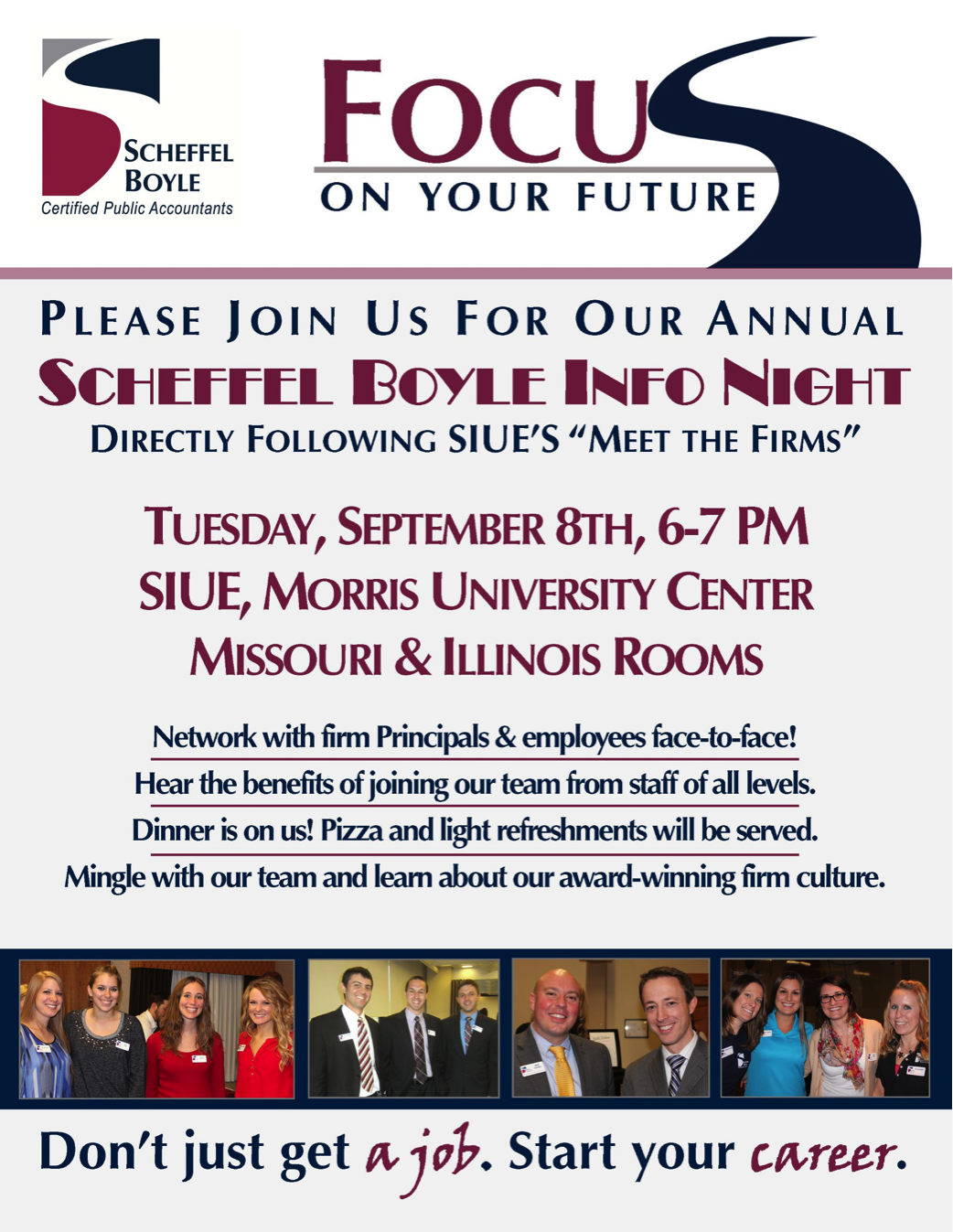
Our Annual Info Night at SIUE is almost here! Spread the word to accounting students you know who want to start their career at an award-winning firm with a rich history in Southern Illinois.

https://scheffelboyle.com/wp-content/uploads/2018/06/Untitled-2.png 1347 1042 brett@bonniburns.com https://scheffelboyle.com/wp-content/uploads/2022/06/Transparent-Logo-5.png brett@bonniburns.com2015-08-26 09:28:092018-07-31 10:37:58SIUE Info Night Is Almost Here!

Scheffel Boyle Named a Future 50 Company

August 26, 2015

St. Louis Small Business Monthly has recognized Scheffel Boyle as one of its 2015 “Future 50” companies in St. Louis. Each year, the publication selects just 50 fast-growing, top small companies in the St. Louis region from hundreds of nominations. According to Ron Ameln, President of St. Louis Small Business Monthly, “these companies will play a large role in the future of business in St. Louis.”

Scheffel Boyle saw significant growth and change in 2014, which had a part in the firm’s recognition for this award. In early 2014, Scheffel & Company, PC, and J.W. Boyle & Co., LTD, merged to form Scheffel Boyle, which increased the firm’s geographic footprint from five offices to eight and added approximately 20 employees. Then, in October of that same year, Scheffel Boyle joined forces with the long-standing CPA firm of Allison Knapp & Siekmann, which also further expanded Scheffel Boyle’s reach in Southern Illinois.

“We had a very dynamic year in 2014, and came out of it as a stronger firm. We didn’t just expand in numbers, we added a greater depth of knowledge and expertise to our team,” said Dennis Ulrich, Managing Principal of Scheffel Boyle. “These transitions made us an even more dominant force in our region and a better resource for all our clients. I’m proud to be associated with such a dedicated group of people and accept this award on their behalf.”

Scheffel Boyle, along with the other 49 honorees, accepted the “Future 50” awards at a special luncheon thrown by the magazine on August 19th at the Hilton Frontenac. The winners will also be featured in the magazine’s September “Small Business Awards” edition.

https://scheffelboyle.com/wp-content/uploads/2018/06/Untitled-1.png 694 1042 brett@bonniburns.com https://scheffelboyle.com/wp-content/uploads/2022/06/Transparent-Logo-5.png brett@bonniburns.com2015-08-26 09:25:122018-07-31 10:38:03Scheffel Boyle Named a Future 50 Company

Congratulations Are In Order

August 12, 2015

We are pleased to announce the following promotions throughout the firm. Congratulations to all!

Supervisor:

Lisa Winkeler, Highland

Rob VonAlst, Bartelso


Senior Accountant:

Austin Tebbe, Edwardsville


Semi-Senior Accountant:

Chris Sobrino, Alton

Tim Hall, Edwardsville

Neil Kramper, Belleville

Brett Heberer, Belleville

Jamie Niermann, Belleville

Sarah Kinkead, Highland

Tyler Kunkelmann, Columbia

Danielle Staples, Carrollton

https://scheffelboyle.com/wp-content/uploads/2018/06/pexels-photo-327538-1.jpeg 576 640 brett@bonniburns.com https://scheffelboyle.com/wp-content/uploads/2022/06/Transparent-Logo-5.png brett@bonniburns.com2015-08-12 09:30:142018-07-31 10:38:54Congratulations Are In Order

Howard Held Recognized as “Top Accountant”

August 3, 2015

St. Louis Small Business Monthly has recognized Howard Held, CPA as a “Top Accountant” in the St. Louis region for their annual feature. Each year the publication features top accountants from the St. Louis area as chosen by readers of the magazine. Howard was one of only 13 people recognized this year by the magazine.

Howard is a Manager in Scheffel Boyle’s Highland office and has been with the firm since 1983. He graduated from Bradley University in 1978 with his Bachelor’s Degree and has worked in public accounting ever since. His specialties include audit and tax services for governmental entities, nonprofit organizations, and the agricultural industry. Howard is extremely active in his local community and has volunteered countless hours of his own time toward a variety of causes, and has even won the Highland Chamber of Commerce’s “Person of the Year” award due to his community activism and professional dedication.

“I am very honored and touched for being selected for this award.  From my point of view, I don’t feel that I should be singled out as the recipient.  Whatever skills I have and whatever opportunities I have been given to utilize those skills are the direct result of Scheffel Boyle and my fellow employees. This award is proof of the cooperation and support that I have received from this professional team,” Howard said. “I have always taken pride in the completeness and quality of service given to clientele and that workman ethic, that I credit my parents for, is further enhanced by the firm.  It is part of the Scheffel Boyle way of doing things. And I would also like to thank any and all people who nominated and voted for me to win this award.  I hope they are reading this and that they know how special this is for me and I appreciate their efforts very much.”

Howard and the other dozen honorees will be featured in the August issue of St. Louis Small Business Monthly.

https://scheffelboyle.com/wp-content/uploads/2015/08/IMG_0028.jpg 3561 2496 brett@bonniburns.com https://scheffelboyle.com/wp-content/uploads/2022/06/Transparent-Logo-5.png brett@bonniburns.com2015-08-03 09:32:312019-09-20 08:37:40Howard Held Recognized as “Top Accountant”

Bethalto Office Information

July 2, 2015

With Larry Rose’s retirement being official as of July 1, our Bethalto office has been consolidated throughout our other conveniently located offices. Please contact them by their information below for assistance. We apologize for any inconvenience this may cause our clients. We will do all we can to ensure this transition goes smoothly for everyone.


Alton Edwardsville Belleville
618.465.4288

322 State Street

618.656.1206

143 N. Kansas St.

618.233.2641

2810 Frank Scott Parkway W, Suites 704 & 812

https://scheffelboyle.com/wp-content/uploads/2018/06/pexels-photo-209224-1.jpeg 426 640 brett@bonniburns.com https://scheffelboyle.com/wp-content/uploads/2022/06/Transparent-Logo-5.png brett@bonniburns.com2015-07-02 09:34:382019-09-20 08:38:31Bethalto Office Information

Larry Rose Announces Retirement

June 5, 2015

Larry Rose, CPA, Principal in the Bethalto, IL office, has officially announced his plans to retire on June 30th of this year. Larry’s retirement will mark the end of his 40-year public accounting career.

Larry spent 40 years at Allison Knapp Siekmann, LTD before they joined with us in October of 2014. He is an active member of the American Institute of Certified Public Accountants (AICPA), Missouri CPA Society, Illinois CPA Society, and the Bethalto area Kiwanis club.

Larry is the Principal in charge of the Bethalto, IL office location. Along with Larry’s retirement, we will consolidate the Bethalto office location between our Alton, Edwardsville, and Belleville offices in order to provide a team-oriented service environment for Larry’s clients in his absence.

We are sad to see Larry leave the firm, but excited for him on this new journey is his life. If you’d like to wish Larry well, he can still be reached at the Bethalto location by calling 618.377.2171, or by emailing larry.rose@scheffelboyle.com.

https://scheffelboyle.com/wp-content/uploads/2018/06/hands-walking-stick-elderly-old-person.jpg 426 640 brett@bonniburns.com https://scheffelboyle.com/wp-content/uploads/2022/06/Transparent-Logo-5.png brett@bonniburns.com2015-06-05 09:37:302018-07-31 10:38:25Larry Rose Announces Retirement
Page 29 of 32«‹2728293031›»

Pages

  • 2025 Seminar Registration
  • 2025 Seminar Registration Presentation Slides
  • 2026 Summer Sneak Peek
  • About Us
  • Accounting and Office Manager
  • Accounting Clerk
  • Accounting Services
  • Administrative Assistant
  • Administrative Assistant – Columbia Office
  • Administrative Assistant – Edwardsville Office
  • Administrative Support Specialist
  • Administrative Support Specialist
  • AGCI Webinar Presentation
  • Agribusiness
  • Alton, IL
  • Andrea Suhre
  • Andrea Suhre
  • Audit & Assurance
  • Available Opportunities
  • BDO Alliance USA
  • Belleville, IL
  • Bookkeeper
  • Bookkeeper/Payroll Specialist
  • Brian Otten
  • Business Valuations
  • Careers
  • Carrollton, IL
  • Columbia, IL
  • Construction Accounting
  • Construction Newsletter
  • Construction Tax Seminar Presentation
  • Consulting Services
  • Contact Us
  • Coronavirus Resource Center
  • Cory E. Gallivan
  • Crystal Bock
  • Crystal Bock
  • Dale Holtmann
  • Daniel Phipps
  • Data Entry Assistants
  • Dennis E. Ulrich
  • E-News Sign Up
  • Edwardsville, IL
  • Elements
  • Employee Benefit Plans
  • Experienced Accountants
  • Experienced Public Accountant
  • Financial Calculators
  • Financial Institution
  • FOCUS Internship Program
  • Full-Time Interview Sign-Up
  • George Moore
  • Governmental Entities
  • Heather Clugston
  • Helpful Links
  • Highland, IL
  • Home
  • Howard Held
  • Individual Clients
  • Industries
  • Interview Thank You
  • Interview Timeslots
  • Jerseyville, IL
  • Julie Billeter
  • Julie Graham
  • Kathy Fitzgerald
  • Keith Brinkmann
  • Knowledge Center
  • Lisa Bohnenstiehl
  • Locations
  • Mark Korte
  • Marketing Specialist
  • Michael D. Ulrich
  • Michael E. Fitzgerald
  • Michael T. Brokering
  • Non-Profit Organizations
  • Office Accounting Assistant
  • Our Team
  • Outsourced Accountant
  • Part-Time Bookkeeper
  • Payroll Assistant
  • Payroll Supervisor
  • Peer Review
  • Privacy Policy
  • Privately-Held Businesses
  • Professional Affiliations
  • Recruiting Events
  • Recruiting/Human Resources Coordinator
  • Resources
  • Robyn M. Klingler
  • Russell Gregson
  • Sarah Smith
  • Scheffel Boyle News
  • Scheffel Boyle Shares
  • Scott Weber
  • Seasonal Tax Preparer
  • Services
  • SIBA Webinar Presentation
  • Sneak Peek Survey
  • Spring Tax Internship Program 2026
  • STL Ag Club Webinar Prez
  • Summer Audit Internship Program
  • Summer Audit Internship Program 2026
  • Tax Planning & Preparation
  • Tax Talks Information
  • Tax Talks Presentation
  • Testimonials
  • Webinar Presentation May 14
  • Welcome Email
  • Year-End Tax Planning Seminars
  • Accountant – Carrollton
  • Administrative Assistant – Alton Office
  • Administrative Assistant – Belleville Office
  • Administrative Assistant – Columbia Office
  • Seasonal Administrative Assistants
  • Seasonal Data Input
  • Staff Accountant

Categories

  • Blog
  • Construction
  • Coronavirus Resource Center
  • Frontpage
  • Knowledge Center
  • Scheffel News
  • Uncategorized

Archive

  • August 2026
  • May 2026
  • November 2025
  • October 2025
  • July 2025
  • February 2024
  • July 2023
  • May 2023
  • February 2023
  • January 2023
  • November 2022
  • August 2022
  • July 2022
  • June 2022
  • March 2022
  • February 2022
  • January 2022
  • December 2021
  • June 2021
  • May 2021
  • April 2021
  • March 2021
  • February 2021
  • January 2021
  • December 2020
  • November 2020
  • October 2020
  • September 2020
  • August 2020
  • July 2020
  • June 2020
  • May 2020
  • April 2020
  • March 2020
  • February 2020
  • January 2020
  • December 2019
  • November 2019
  • October 2019
  • September 2019
  • August 2019
  • July 2019
  • June 2019
  • May 2019
  • April 2019
  • March 2019
  • February 2019
  • January 2019
  • December 2018
  • November 2018
  • October 2018
  • September 2018
  • August 2018
  • July 2018
  • June 2018
  • May 2018
  • April 2018
  • March 2018
  • February 2018
  • January 2018
  • December 2017
  • November 2017
  • October 2017
  • September 2017
  • August 2017
  • July 2017
  • June 2017
  • May 2017
  • April 2017
  • March 2017
  • February 2017
  • January 2017
  • December 2016
  • October 2016
  • September 2016
  • August 2016
  • July 2016
  • May 2016
  • April 2016
  • March 2016
  • February 2016
  • January 2016
  • December 2015
  • November 2015
  • August 2015
  • July 2015
  • June 2015
  • February 2015
  • January 2015
  • December 2014
  • November 2014
  • September 2014
  • August 2014
  • March 2014
  • February 2014
  • December 2013
  • November 2013
  • October 2013
  • August 2013
  • July 2013
  • June 2013
  • May 2013
  • February 2013
  • January 2013

About Us


Serving St. Louis, the Metro-East and Southwestern Illinois since 1924.

Knowledge Center

  • New Rules Could Increase Taxable Income for GamblersAugust 24, 2026 - 3:20 pm
  • IRS Notice CP53E and the Rise of Refund-Related ScamsMay 18, 2026 - 9:55 am
  • Potential Refund Deadline Extensions Under the Kwong CaseMay 7, 2026 - 11:40 am

Quick Links

  • Services
  • Clients & Industries
  • Our Team
  • Scheffel Boyle News
  • Careers

 Contact Us

Alton, IL: 618.465.4288
Edwardsville, IL: 618.656.1206
Belleville, IL: 618.277.8100
Highland, IL: 618.654.9895
Jerseyville, IL: 618.498.6841
Columbia, IL: 618.281.7605
Carrollton, IL: 217.942.3821

© Copyright 2021 Scheffel Boyle — All rights reserved
  • Site Map
  • Privacy Policy
Scroll to top Scroll to top Scroll to top